 varingblaar
Mercy
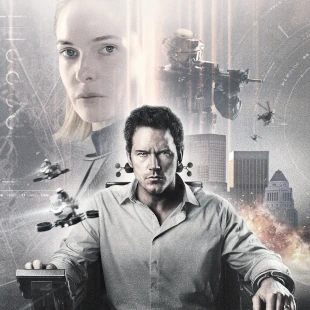
 Spoiler warning: If you haven't seen Mercy, I suggest you do so before going any further. If this spoils it for you, it's not my fault.
You have been warned.
Science fiction tends to show what we most fear, and nowhere is this more true than Cyberpunk. When repeated often enough, they become tropes of the genre, and Mercy is no exception. The reason these things come up is because they're relatable. It feels conceivable that we could end up in these situations, or in some cases we see it starting to happen already.
The AI Take-Over
In this case specifically the relinquishing of control to AI, either for convenience or to remove human error. SkyNet in Terminator was meant to have control over nukes to remove human error, and we know how that went. WOPR in Wargames is similar. VIKI in I, Robot was meant to run the city's infrastructure, but came to the very logical conclusion that the biggest danger to humankind is humans themselves.
In Mercy there's a courtroom that uses every piece of information available to decide the fate of a person. Then it executes on that decision with impunity. There's a reason convicted persons remain on Death Row for many years. Because there's always a chance that "we missed something", and once you pull that lever it's too late. You can't bring them back.
Invasion of Privacy
Oh this is a big one. Mercy Court has access to virtually every piece of media that exists, and every hardware input and sensor in the city. A lot of this is simple OSINT, Instagram posts or a publicly accessible bird watching camera (yes really). But occasionally we access a camera and I think "there's no way that's legal, right?" When someone realises exactly how much of their actions are known, it is offensive to them on a visceral level. And I would too. It's difficult for us to understand exactly how much information we "leak".
The Class Divide
There's rich, and there's poor. The rich live in a utopia, the poor live in squalor. In a lot of fictions the utopia can only exist because the slums exist. Sometimes these organise themselves into places you don't go, and the narrative is greatly altered by which side of the proverbial fence the story takes place. Historically it may be the other side of the train tracks. In Altered Carbon it's the lower levels, in Alita Battle Angel it's the Scrapyard. In Mercy it's the "red zones". It also appears that people were forcibly relocated to these red zones, which makes it even more of a divide.
Electric Sheep
"Do Androids Dream of Electric Sheep?" by Philip K. Dick, the story Blade Runner was based on, about whether machines can feel. We've seen this a million times. There's some story thing a machine can't do because it lacks compassion and understanding, or it fails to see the value in "life", or it has no sense of "self". Again, this is a trope because it feels familiar. As large language models get better at mimicking our own behaviour, we anthropomorphise them. We see personality and preference. It feels "alive".
In Mercy, the AI has perfect knowledge and is perfectly logical, but it lacks compassion and it lacks "gut". The big plot twist that makes Judge Maddox glitch, have a change of faith, and start actively breaking laws herself to help the hero in favour of a "greater good" is because the AI doesn't have a "gut" to follow.
But what is "gut"?
Apparently we make 35000 decisions per day. What we call our "gut" is basically our brain making decisions for us, based on previously observed patterns, so that we don't have to pay attention to it. Often we can't explain exactly why we draw the conclusions that we do. Isn't that exactly what an AI does?
The Actual Story, and Why The Plot Don't Plot
So now we have this AI that can "see and hear everything" and has perfect knowledge of all evidence. Then the accused is given an arbitrary amount of time to plead their innocence when there's a big score board telling them that they don't really stand a chance. And when that timer runs out, they are executed on the spot. No chance for appeal. I mean, what could go wrong?
I think in a normal Mercy Court case, the accused would explain their side and the AI judge could cross-reference evidence to corroborate and create enough doubt to delay execution. But over 2 years this has never happened? A 100% guilty verdict over 18 cases feels very unlikely. The sessions are being recorded, but are they being checked?
The problem is, we often ship tasks to AI specifically because they're too difficult or time consuming to do ourselves. The "big reveal" is the fact that they missed evidence in a previous case. Evidence that would've been known to the AI Judge. Jaq (the partner) didn't report the phone call informing them of this, but after watching Maddox (that's her name, by the way, the AI Judge) do her thing for 90 minutes, there's no way she would've missed it. It's literally timestamped. And if it was possible for someone to intervene and hide that evidence from Mercy Court, it defeats the entire purpose for Mercy Court to exist. So... huh!?
The Actual Movie, Though
The movie drops you in the deep end and does not let up. The trial happens in near-realtime, but not quite. Close enough that it feels realtime. It goes at a breakneck speed the entire time. Editing is difficult to follow, as cameras change from phone cam to body cam to dash cam to helmet cam. But it's all center-framed so not a lot of looking around or missing things.
"Reconstructions" given to Chris during the trial don't seem reasonable in context, or even that practical really, but damn they look cool! Especially when he is sat in the middle of a live explosion that's somehow being projected around him in 3D, when every camera in the area had been damaged or destroyed. It looks awesome even if it doesn't make sense.
That's the thing though. The movie is fine. The story is exciting, the special effects are pretty good. It does that thing where the digital hacking world spills into the real world. It's the guy from Guardians of the Galaxy and Jurassic World (he actually does the hands up thing a couple times), opposite the mom from Dune.
Watching Mercy wasn't a waste of time, but now I've seen it and it was fine and I'm probably never going to watch it again.