 varingblaar
Project Hail Mary
 Spoiler warning: If you haven't seen Project Hail Mary, I suggest you do so before going any further. If this spoils it for you, it's not my fault.
You have been warned.
Full disclosure, I read the book in 2023 and listened to the audiobook last year (2025).
Besides knowing what's going to happen for the most part, it's amazing to see it presented in such a visually stunning way. Once you know the broad strokes of the story, you're not watching to see what happens, you're watching to see how they interpreted the material differently from how you did. Obviously the movie looks incredible, even just watching the trailer would've told you that. But the editing has some cool details.
When a flashback begins, it takes the camera a moment to stop floating and settle down. Almost like you need to wait for your head to stop spinning. Returning to the present is much more abrupt, but are often masterful match cuts. Ryland's shoes on Earth cutting to the same, now more tarnished, shoes on the Hail Mary. A little deep sea diver figurine at the bottom of a fish tank cuts to Ryland in his space suit. That sort of thing. Every time it happened I caught myself thinking "oh that was a nice cut."
The Sound
Wow the sound! Firstly, there was a score through most of the movie but it's so subtle and composed (haha) that I didn't notice it for most of the movie. You feel the music instead of hearing it. Except of course when it's karaoke night, then obviously there's music, but you know what I mean. There are a few major set pieces where the sound design does some heavy lifting.
During the first contact scene we see from Ryland's POV inside the helmet, hearing the sound of his rapid breathing. The thunks and scrapes of the suit are reverberations through the suit, because outside there's no air so outside there's no sound. I saw several people in the cinema sit forward in anticipation.
During the Adrian mission, when the thing bonks him in the head. The sudden impact made me wince and cry out, and I wasn't the only one. Same when the pilot seat comes loose and flies forward, which was a dramatic moment even in writing. The timing, the editing and the sound design absolutely nails what it feels like when something like that happens to you.
And lest we forget the explosion. Casual conversation, people walking, hey what's that flash in the background? Then the shock wave hits, and then the sound follows. Or was it the other way around? Either way, there's just enough time to think "oh shit" before it hits. And it's not a boom to be all dramatic like in other movies, it sounds like a real explosion; Just a bunch of air assaulting your ears. Panic and confusion ensues, as one would expect, camera all over the place. Slowly we figure out what's happened and the implications towards the mission. It's such a good scene.
So... Rocky
Probably have to talk about this at some point... Apparently a lot of design went into the character long before they even though about how it would be brought to screen. Yet it ends up looking pretty much how I expected it to look. Could be that Andy Weir describes it more from a functional point of view rather than aesthetics, although he does explain the mottled rocky exterior at some point, but I saw Rocky in one of the later trailers and thought to myself "yep, that's it, no notes". That feeling persisted through most of the movie.
It must be really tricky to give a personality to something that doesn't have a face... His movements and voice does an amazing job of portraying a highly intelligent creature frustrated with its inability to communicate effectively. I don't know what text-to-speech engine Ryland's laptop has, but there's a crazy range of emotion in that digital voice. Don't care, it works.
Page to Screen
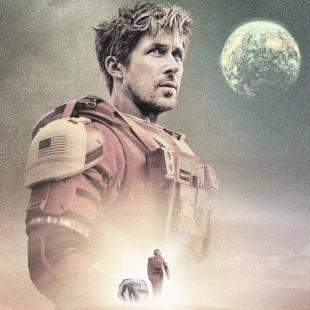
The casting was pretty good. When I saw a trailer with Ryan Gosling it took a moment for my head canon to update, but after that it was fine. I guess this is just what Ryland Grace looks like... Again, it could be that he was deliberately left vague in the book. Same for Stratt; I don't think I had a mental picture of the character until Sandra Hüller "became" Stratt in my head.
The movie has some major differences plot-wise from the book. Obviously you have to condense the story for the sake of time; A novel is enough story for a season or more of a series, so things must be cut. The way Ryland wakes up at the beginning of the movie was clearly shortened from the original. The first few chapters of the book has Ryland literally relearning how to speak before the hatch would even open, followed by experiments to figure out why gravity is weird. It's fun to read and makes the character likeable and relatable, but the movie doesn't have time for all that: Open hatch, big window, "My God, it's full of stars!"
In the book there's a whole story arch about a genetic reason certain people can't survive extended hibernation, which is why Ryland was the only suitable replacement astronaut. In the movie it's pretty obvious it has to be him, even before they justify it to him.
And then there's a couple things they changed for aesthetics that I don't mind, but don't really understand why. The biggest change is how the ship centrifuge works. There's actually a drawing of it in the book, that makes it into a "bolo scheme" (Seveneves reference). In the movie the middle section moves out, which is fine, and then turns 90° which... wait... so now every room in the ship has two floors; One for thrust gravity and another for centrifugal gravity? But when you think about it, Rocky is supposed to roll around inside the ship, which wouldn't make sense if the ship was mostly vertical like in the book. Yet you never question it while reading because it doesn't affect the narrative.
Oh also! They connect up and spin so they can both have gravity! I don't think that's a thing in the book. They keep having to stop the spinning to do stuff. Which makes sense, I guess. But that monstrosity of the two ships spinning in space feels very lopsided. I guess Rocky's ship, being made from xenonite, we don't know how much it ways so we can't verify the physics... but it looks weird...
Last major change I can think of, although I've probably missed some, is Carl.
Carl
In written fiction there are ancillary characters that progress the plot. This is a known thing and it's not a problem because you can spend several pages getting to know these characters and it makes sense for them to be there. In a movie you don't have that kind of time, so often a whole bunch of ancillary characters can be rolled into one supporting character that we can get to know a little more. In the case of Project Hail Mary, I think that's what Carl does.
In a way Carl represents "the rest of humanity". He's close enough to the project that there's a reason for him to interact with Ryland, but far enough removed that he's not "one of the specialists". He's human enough that we can see how the end of the world is going to affect him, but because we know the character he's not just one of the millions of people on TV. He makes the rest of humanity relatable, helping us process the inevitable end of the world on a more direct, personal level.
The Verdict
They managed to turn an 8/10 book with a 9/10 audiobook into a 7/10 movie. It's a great movie and I can't imagine anyone would regret watching it. We need more approachable science fiction movies that don't shy away from the science for the sake of "mass appeal". As soon as it's available on streaming I'll be watching it a couple more times.