 varingblaar
Sherlock Holmes Consulting Detective

fun nonetheless
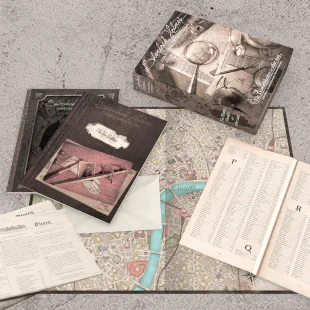
My version of the game is the older Ystari print. Currently the game is printed by Space Cowboys under the name "The Thames Murders & other cases" because there's a series now, but the contents is the same. It's a pretty heavy box for its size. Inside is a thin rulebook, an address directory, a map of London, a stack of newspapers and ten case books.
It's not strictly speaking a campaign game, and there's very little overarching story between the different cases, but it is best to play them in order with the same players. There's a newspaper for each case, but for each case all newspapers dated earlier might be relevant.
The Basics
Each case begins with an introduction. Mostly it explains what the case is about, and why Sherlock is too busy to attend to it himself, instead sending the B team. That's you.
Gameplay is an elaborate "choose your own adventure" system. If we want to speak to Bob, we look up Bob's address in the directory (something like 39 SE) and then find that entry in the case book and read it aloud. Make a note of every location you visit, because you can calculate a score at the end.
The next couple hours is a bunch of brainstorming to decide where to go next, reading that entry, then trying to parse new information. Sometimes the new clues is the lack of information, and requires going through notes and finding alternative lines of inquiry. This is the fun part of the game.
At the back of the case book is a list of questions. The first three are the main objectives; Who's the culprit, why did they do it, and usually something specific to the case. Below this is a second set of questions that are optional, but if you did your job correctly they're fairly simple to answer. Then the conclusion is read and score is calculated. Main objectives are worth 20 point, secondary objectives 10 each. Then points are deducted for each location visited.
Here's My Problem
In my opinion the scoring system is counter-intuitive. I understand it's a board game and board games apparently need scores. But it's a mystery game. Once you've read the answer, it's not like you can go back and try again. Lend the game to a friend and they play through it with their group, then compare scores to see who solved it better. That's not really the point. It seems a pointless exercise.
Having a score system that penalises for locations visited, changes how the game is played. When playing for the best score, you would read the questions and visit the fewest locations possible. This means jumping to conclusions or following wild leads and then guessing the answer with less information than we're comfortable with, or accepting vague answers as correct like a bad daytime game show. The authors spent so much time writing the backstories and extra details, even adding picture clues sometimes. Should the point not be to enjoy the story?
The cases are well designed, but the clues are written from the perspective of someone who already knows the answers. Does that make sense? After the conclusion, the case book offers the optimal path to high score. Reading through this often ends with "how the hell were we supposed to know that?" In their defence, if they spell everything out it would be too easy, and it's impossible to balance the difficulty of a game that relies so heavily on interpretation. It's not a sudoku with a quantifiable difficulty, it's a series of word puzzles.
How we choose to play, is to ignore the scoring system entirely. We don't even look at the questions because sometimes their wording can be a spoiler. We just go from place to place, gathering clues, enjoying the atmosphere and working it out. If it means we visit every location in the case book so be it, but we follow every lead. When we feel happy with our conclusion or have run out of options, we go to the questions. If we answer the primary objectives, we call it a win. For my group this is the best way to play, but you do you.
If you're interested in trying it, there's a short demo on their website to print out and try.