 varingblaar
Tea Witches
steeped in glory!
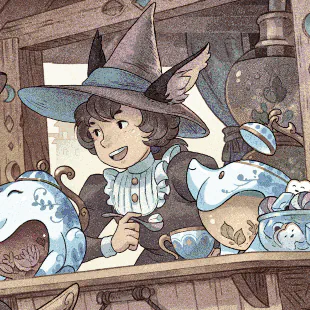
I have to be honest, before taking the plunge on this one it seemed daunting. Even after watching it be played felt like a lot to remember. But the amazing art by Sandara Tang (also Flamecraft and Critter Kitchen) and many tea puns and witchy puns, I went for it.
It turns out the rules aren't that complicated. The rulebook is well designed with many examples, though sometimes the nuance of a rule is hidden within an example. If the rules were stated more explicitly and nuances clarified, it would be a quicker learning experience. Luckily it's easy to crowd source clarifications through Reddit or Board Game Geek.
Gimmicks and Puns
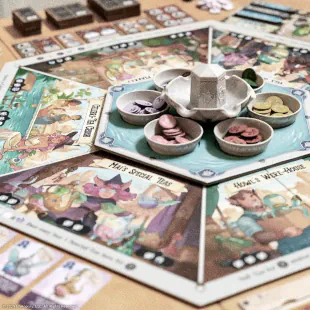
First thing you notice is the plastic fountain. The centre of the board is a lazy Susan with the six different teas. During the game this thing turns, moving tea flavours next to different spots. The fountain is probably not necessary and takes up a significant portion of a large box. I don't like big board elements like this unless they serve a purpose. The bowls are necessary, but the fountain didn't need to be there. Considering the game has an upgrade kit, I would've preferred the fountain in there, the box smaller, and the game more affordable.
Around the central fountain are six BOOtiques, each with three Pup Stops for your TeaPups. That's literally a sentence I had to say out loud. So many puns. For most of teh BOOtiques there are additional cards or a special board that go around the outside of the board. These locations include Witchy celebrities at Celebri-Tea Crush, a Were-House managed by a Werewolf named Howl, and Hex Support where you can buy upgrades. Special teas are single-use cards, but really didn't need to be called Special-Teas (ugh). Teas can have toppings; These are Eye Cubes, Sweet Teeth, and Boba Bugs. During the game, serving Basic Bitches Witches earns money or Loyal-Tea.
Oh did I mention, the whole event is the Teaquinox Faire, featuring events such as Broomstock and Witchella.
Art and More Puns
The art style is not just cute for the sake of cute, there's an internal logic. Within your deck of cards are six covens that each have a distinctive style and fashion sense. Each of the four player boards is represented by the coven of that particular colour, which extends to their TeaPup movers. Each of the BOOtiques has a mood that makes them easy to identify, with fun characters in the artwork. The special teas are depicted in ornate teapots styled to show the ability of the card. It all feels alive, like it's moving.
An often overlooked details I appreciate, is the denominations of coins are different shapes. Quickly counting or grabbing the right one is effortless. If we're designing pretend coins, there's no reason to stick to real-world practical limitations. Marginally larger circles is not good enough.
I appreciate the little Starbucks reference on the Loyal-Tea Reward token...
Actual Gameplay
First part, start of the day. Little bonus and a new to-go order for each player.
Then the Summoning, a little personal mini-game everyone plays at the same time. Flip a card, do what it says, choose whether to press your luck or stop flipping. Most of these flipped cards are the customers you'll be serving this round, inaddition to the loyal customers from the previous round.
Now we play the actual game, Service. In turn order each player places a TeaPup, takes the Pup Stop actions, does what the BOOtique location says, and then serves as many customers as possible. Then we all look at our to-go orders to see if they match the board. Next player. This continues until all TeaPups are placed.
End of day. The most important thing that happens here, is all unserved witches are discarded. Those loyal customers from before, if you didn't serve them they leave. TeaPups come home with their teas, board updates a bit, and we go again.
Once you have this flow down in your head, the gameplay is actually quite smooth. I'm not sure why it looks so complex, but once I realised it's actually this simple, the Teach became much quicker and new players understand faster.
The Mechanics That Make It Fun
Unserved customers leave, and you only score the customers you've served in the last round. Each progressive round there are more customers to serve, but you're building a system of gaining and storing more resources to facilitate this. At the halfway mark you also get a third TeaPup to help. This means the game starts with only a couple options, but by the end of the game you're placing a TeaPup and triggering a chain of a dozen actions that results in several customers being served. It's very satisfying but never feels overwhelming, because each element of that engine is added one step at a time.
Customers care about which teas I have access to. To-go orders care about teas a particular BOOtique has access to, regardless of who owns them. That dichotomy is very interesting, especially because serving a to-go order often gives loyalty to other players.
During a particular turn, the BOOtique is usually the driving factor. "What do I want to do? This one." and then take the best Pup Stop there. As the game becomes familiar, the position of the Fountain becomes a factor. Occasionally the best choice involves an unwanted BOOtique to position the wheel and score multiple to-go orders.
Better Bits
There's an upgrade kit for the game. It includes wooden tokens for toppings, acrylic beads for the tea, and...
Actually that's it. $25 plus shipping to make the bits nicer. Personally I like that the base game is consistently cardboard, instead of a study in mixed media. The wooden toppings are nicely printed, but the acrylic tea beads don't have the distinctive tea leaves on them and could me more difficult to identify for persons with colour blindness.
What I would've done, is put the big plastic fountain in the Upgrade kit. The game box could flatter, reducing distribution costs without sacrificing too much shelf presence, in turn reducing price. $60 isn't a bad price for this game, but lower price is always better.
I'm also a little annoyed that the rulebook advertises the upgrade kit. Is that necessary? There's a publisher leaflet in the box. Could a little leaflet for the upgrade kit not make the rulebook cleaner and more professional? Do even our board game rulebooks need mid-roll ads now?
Overall
A decade ago, there were two distinct camps of board games. Games with cute art were light on mechanics, easy to teach and fairly short. If you wanted a more in-depth experience, the theme was often sci-fi or dark fantasy with very few exceptions. That's why I'm happy there's a movement towards games with a bit of meat, what's considered "medium weight" with a whimsical theme. Tea Witches is "thinky" enough that it feels rewarding, but light enough with cosy art that it feels fresh (tea joke?). The rules could've been explained a little better to help first time players, but once the rules are learned it's easy to teach.
The art is flawless, except for some repetition. It's not as noticable in the player cards as there's usually only one of any colour card visible, but the Celibri-Tea and Special-Tea cards often deal two cards with the same art. A bit more variety in these would've been nice but it's a very minor gripe.
The game can be a bit of a table hog. The hexagonal board maked it difficult for players to put their player boards next to it near the edge of the table. Most of the BOOtiques have an extra board or a set of cards dealt next to them, expanding the footprint further. Your player board needs to be quite a way from the edge of the table because cards are played below it and to the right of it. Even a standard 6 seater dining table has a bit of difficulty fitting all four players.
Overall definitely worth the play if the whimsical theme is something you're comfortable with.