 varingblaar
And Then There Were None by Agatha Christie
but now on screen
 Spoiler warning: If you haven't finished watching And Then There Were None, I suggest you do so before going any further. If this spoils it for you, it's not my fault.
You have been warned.
While reading the book I discovered many adaptations of the work over the decades. The one that took my fancy was this British limited series. For my comments on the actual story, please read the previous article. This will be about the series itself and how it differs from the book.
Cast
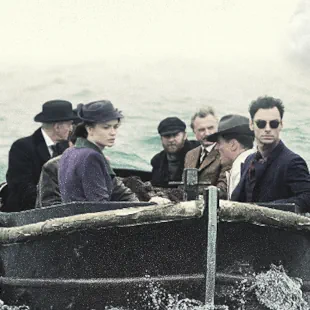
Let's start with the actors I recognised from the poster, and immediately knew which character they played:
- Charles Dance, Tywin Lannister obviously, but also Leopold Frankenstein, is a good choice for Justice Wargrave, though in my mind the character was heavy set and prone to anger. I might be wrong.
- Sam Neill, Dr Grant in Jurassic Park, as General MacArthur. I didn't form enough of an opinion about MacArthur to judge this casting. The emotional scene on the beach was clearly not the actor's strong suit, but considering the general spent his life hiding his emotions it sort of works.
- Toby Stephens, Captain Flint in Black Sails, as Dr Armstrong is absolutely perfect. Probably my favourite of the series.
- Noah Taylor, Mr Buckets in Charlie and the Chocolate Factory, as Mr Rodgers is pretty spot on. He nails the balance of timid while serving, but controlling over his wife.
- Burn Gorman, who I know as Murtry in The Expanse, as Blore. Eh. Could've really been anyone.
The others were not as obvious who they were, but made sense once introduced. Marston was the prick I expected hom to be, in the series even more so than the book. Emily Brent made me socially enraged several times at her brazen classism, if there weren't servants the nearest person she considered "below her" would do. Lombard didn't really make sense for the role but is probably fine.
Changes to Backstory
A few things from the book were different in the series. Some of them make sense, as a book usually doesn't directly translate to screen. Others changes were made for dramatic effect and I'm not sure how I feel about it.
The biggest change is some of the backstories, seemingly changed to have a more emotional reaction, or to be morally more "wrong". What upset me the most was Blore. In the book he provided false testimony and the fall guy died in prison. In the series he beat someone to death, seemingly because he's gay. I didn't like the character before, but I like him even less if he's homophobic.
Emily Brent from the book felt justified in her decision to kick out the "pregnant girl" under her charge, and showed no remorse even after Beatrice drowned herself. In the series it's heavily implied that Brent had feelings for Beatrice, and when she fell pregnant she popped the little idyllic bubblethey had created. Brent's decision to kick her out was not motivated by simple religious self-rightousness, but by anger and feelings of betrayal. This gives the character a little more depth, and makes the stone faced woman feel more human. This change I actually like.
Armstrong from the books had left a group of tribespeople to die, mostly for racist reasons. This would've been fine. In the series he actively killed and plundered for diamonds.
MacArthur from the book sent his wife's lover on a mission that ensured he would not return. In the series he outright shot him in the back of the head, and then presumably used his rank and the chaos of the war to hide the crime. This doesn't make a difference either way.
And lastly Miss Claythorne, who's backstory functions as a motif through the three episodes of the series and remains unchanged from the book. What is different, is how it is portrayed. In the book it seemed that Vera suggested Cyril try swim out to the rock, waited a little bit, and then tried to save him. In my mind she may even have regretted her actions and tried to save him before it was too late. In the series she makes no attempt to save him, enjoying the silence of the moment while my mind screams to save him. This didn't sit well with me, and casts the character in a completely different light. Where in the book I didn't understand her sudden urge to hang herself. For the series it could be her naive dreams were shattered when confronted with the truth of her actions, seeing how others react, and over time eat away at her conscience, shooting Lombard being the final straw. But it feels like it's not explained well enough on screen. More on this later.
Changes to Flow
Minor things, really. They don't alter the story as much as I feel the backstories do, but they made me go "oh this is different" a few times.
It's difficult to show guilt or an emotional struggle on screen. For Miss Claythorne, this is shown with frequent hallucinations. It actually gives the show a bit of a Horror ambiance. Most notably, a hand emerges from the bathroom basin and grips her by the throat. In the book, she walked into her room to see seaweed hanging from the ceiling and triggered a weird flashback or emotional break. To be honest, the series version makes more sense. Were women really considered to be so weak-willed in the 1930's?
Speaking of Miss Claythorne, I don't remember any sexual tension between her and Lombard in the book? There's also a whole party scene with brandy and cocaine that gives them a chance to bond and for the others to suspect them, which I don't remember at all from teh book. Was this for more romantic interest to make the story more interesting? It doesn't make a big difference, only confused looks when he leaves a different room and Wargrave mentioning it during the final scene. Again I feel it cheapens the character into a "final girl" trope that really wasn't necessary.
Book Blore got hit in the head with a bear sculpture mantle clock. I commented at the time that it seems unlikely the killer could plan for that. In the series he dies from a garden variety stabbing and covered with a bearskin rug. It seems more feasible under the circumstances, though I'm not sure how weak old Wargrave would get the body into the house on his own.
And then the piece de resistance. In the book Wargraves confesses his entire plan in a multi-page message in a bottle. That wouldn't be very fun on screen, listening to a voice-over as the big reveal. So in the series, he reveals himself to Miss Claythorne as she's hanging from the noose in a very dramatic final scene, the culmination of the series. For the series this is perfect and typical of the genre. A proper end to the series.
Wargrave's final death doesn't rely on a weird elastic contraption, instead ending in a surprisingly accurate throw across the room. Probably fine.a
Overall
Before the "Netflix Original Mini Series" was a thing, British limited series were the best for these sort of stories. Longer than a movie, shorter than a Series. Give time to explain the plot and slowly reveal all the clues, but doesn't have to set up for the inevitable "season two". This is a prime example of exactly that. However the constant pressure to "modernise" a story or make it more "dramatic" has added a couple scenes that make it difficult to recommend. There are a crime thriller lovers in my life that would enjoy this story, but would not appreciate certain things from the series. I guess in that case they can read the book...